
If you have not yet seen the aforementioned epic series, which contains confounding time conundrums, please click here.
If you have, then perhaps you could illuminate the situation. I finally got around to watching all three movies. In a row. Naturally, I had a few questions, the most important of which is this: is the story a paradox?

Secksy.
According to trusty ol' Wikipedia, the definition of a time paradox is as follows:
"A paradoxical situation in which a time traveler causes, through actions in the past, the exclusion of the possibility of the time travel that allowed those actions to be taken.
The typical example is that of the grandfather paradox, wherein a time traveler goes back in time and kills his grandfather before his mother or father is conceived. It is a paradox because if this occurs, he will never be born, and therefore never be able to travel back in time to kill his grandfather, thus allowing himself to be born."
BECAUSE YOU'VE SEEN THE FIRST BACK TO THE FUTURE, you know that there are no grandfather killings. Instead my inquiry resides in character relationships: the scriptwriters make no mention of how Marty and Doc Brown know each other at the beginning of the movie. Does Marty work for Doc? Are they friends? Neighbors?

Emmett 'Doc' Brown. My hero.
I thought that because Doc Brown actually meets Marty in the past/1955, he simply sought out future Marty in 1985. Throughout the "Marty's-about-to-disappear-forever" ordeal, Doc emphasizes the danger of knowing one's own future. So perhaps Doc chose not to say anything too revealing until after Marty came back from the past. In this way, Doc Brown and Marty would not have met unless Marty went back to meet him in the past. And Marty would not have gone into the past unless he knew Doc Brown. Voilà! Paradox.
After watching Back to the Future 2 and 3, however, Doc explains to Marty that creating a time paradox would disrupt the space-time continuum, essentially 'sploding the universe. What they must create, then, is a time loop. They must alter as little as possible in the past or future, thus ensuring the consistency of the current 1985, but inevitably an alternate 1985.
For example, Marty and Doc Brown meet at Twin Pines Mall to perform Doc's time experiment. Yet after Marty accidentally enables the flux capacitor, sending him back to 1955 in the first movie, he runs over one of the pines.

See the difference?
We must remember that the 1985 to which Marty returns is not the same 1985 from which he left. Therefore Marty and Doc knew each other regardless of whether Marty went back in time or not. His going to 1955 just arranged an earlier meeting.
So, no paradox. Just alternate universes. Right?
THEN WHY DOES DOC HAVE THIS WESTERN-LOOKING GUN!?
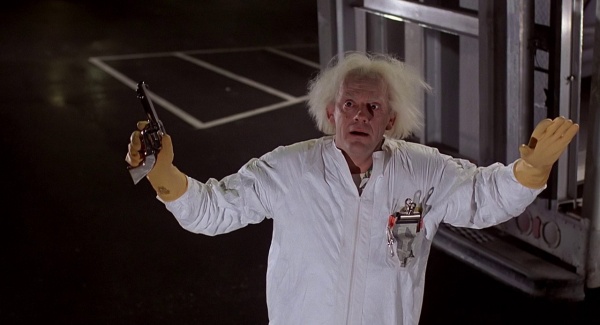
Back to the Future 3, anyone?

No comments:
Post a Comment